Employer review data is only as useful as your ability to ask it questions.
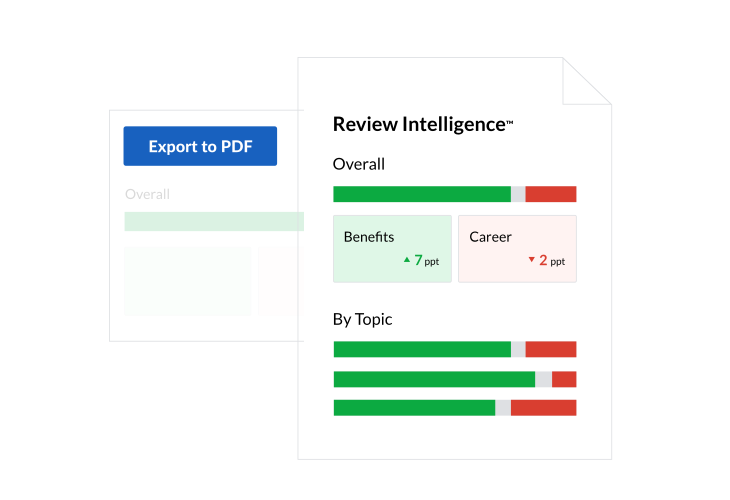
Review Intelligence is Glassdoor’s analytics product for employers — a suite of data pages that surfaces trends, sentiment breakdowns, and benchmarks from employee reviews. It gives HR and employer brand teams a structured way to understand how their company is perceived across time, topic, and demographic.
My work was focused on the frontend layer that made the data legible and interactive. The product lives or dies on whether users can find signal in the data quickly — which meant the visualization components and the filtering system had to be both capable and fast.
Data visualization
I built the core visualization components used across the Review Intelligence data pages. These components needed to handle a range of chart types and data shapes, adapt across different content widths, and remain readable at small sizes on mobile. I worked closely with design to establish consistent visual conventions — axis treatment, colour encoding, tooltip behaviour, empty and loading states — so the components felt like a coherent system rather than a collection of one-offs.
Getting the details right at small viewports was a consistent constraint. A chart that communicates clearly on a 1440px dashboard can fail entirely on a 375px phone screen. I treated mobile not as a fallback but as a first-class target, adjusting density, label handling, and interaction affordances per breakpoint rather than scaling down the desktop version.
Filtering and interaction
Filtering is the primary interaction model in Review Intelligence — users slice data by time period, topic, rating, and demographic attributes to explore what’s driving the numbers. I built out the filtering interaction layer, covering state management, URL-driven filter persistence, and the UI components that expose the controls.
A filtering system has to stay out of the way when it’s working well. That meant keeping the UI lightweight, making applied filters visible and easy to remove, and ensuring that filter changes produced fast, predictable updates to the visualizations beneath. I paid particular attention to mobile — touch targets, drawer-based filter panels on narrow viewports, and the full filtering experience remaining functional without a keyboard or hover states.
Component collaboration
Review Intelligence spans multiple data pages, and the frontend team was building them in parallel. I collaborated with the team to produce the shared suite of core components that each page drew from — standardizing APIs, aligning on prop contracts, and iterating on component behaviour based on the needs that emerged from real page implementations.
Working across a shared component surface in parallel with active page development requires discipline: breaking changes to a shared component can block several teammates at once. I kept interfaces stable and additive, communicated changes clearly, and contributed to the review process to catch regressions before they propagated.
The Review Intelligence work reinforced something that’s easy to understate: component authorship at scale is as much about contract design as it is about implementation. Stable APIs, predictable behaviour across viewports, and systematic mobile coverage aren’t nice-to-haves when a shared surface is in active use — they’re what makes parallel development possible.